skip to main |
skip to sidebar
I was recently meeting a friend for drinks in Ikebukuro, one of the major train stations of Tokyo. My friend Damiano was quite a bit late, around 25 minutes, so I had to wait at the station. With no book in my bag it could have become  a little boring. But I got a free spectacle that certainly made excellent entertainment.
There is a phenomenon in Japan that is called "Nanpa". It generally means something along the lines of "flirting", see the following link for a more historical background on the term : http://neojaponisme.com/2007/12/05/nanpa-a-history/. These days it is used for pick up lines on the street and there are certain areas that are especially popular for this, eeh, sport... Tokyo`s main spot would probably be Center Gai in Shibuya where all the male and female fashion dolls like to spend their time at. Or the square in front of Shinjuku`s South East Exit. And definitely the Ikebukuro station area. Ikebukuro as a nanpa spot has even found literary mention in Ira Ishida`s novel and manga "Ikebukuro West Gate Park" (http://en.wikipedia.org/wiki/Ikebukuro_West_Gate_Park). As one of the more seedy areas of the city and with an abundance of love hotels it seems an obvious choice  for nanpa...
So there was this group of guys standing at the East station exit. Excuse the poor quality of the pictures, I took them in a as unobvious as possible fashion with my mobile phone... Quite clever, three guys representing three distinctly different types and tastes. There was a) the epitomy of the Japanese Male Doll or "Gyaru-O" (girly guy) with the "Tina-Turner-in-the-80`s" hairstyle dyed in blonde, super tight trousers, long pointed shoes, all sorts of bling bling and a stupid "I`m so hot" expression on his face. Then b) the Macho Guy. Short hair dyed in sand blond, heavy fake tan, baseball cap and a intentionally manly body posture and facial expression, the internationally recognized "I`m the man" type. And then c) a less obvious candidate, the Nerdy Guy or "Otaku" as they are called here. Next to his friends an obvious lack of fashion sense, glasses, undefined haircut. Still, unlike the typical Otaku definitely not of the shy stay-at-home-and-play-video-games type. In a refined approach that would have made anyone working in Sales jealous, those guys  scouted the area for girls to tackle and chose the appropriate team member to address her instantly. I seem to be the macho type target - lol. When I arrived the guy too a closer look at me and seemed to consider addressing me. But they are cowards, so the risk of me not speaking Japanese seemed too big I guess. It was really funny to watch and they were very busy as the approach of Nanpa is not class but mass. Chat up as many girls as possible and try to get their phone numbers. Most will probably be annoyed and leave, but if you approach enough you will get SOME phone numbers. That is the philosophy of Nanpa I guess. The girly guy targeted the dolly girls, the "Hime" gal, princess girl and the super fashionistas. The macho targeted the more streetsy but still fashionable type. And the nerd the shy, office girl type. Despite the obvious stupidity of the endeavour as such I thought their way of approaching the "market" was kind of brilliant.

I failed to count the number of girls they chatted up during these 25 or so minutes, but there were quite a few. They were insistent too, so if the girl kept on walking they would just walk with her for a bit to still talk her into handing over her phone number (or ideally go straight for the love hotel I guess). They did not chat a lot with each other, though obviously being there as a group. In between the chat-ups they would be checking their mobiles to keep track of past success stories I guess and scout the area for new "customers".
The most clever of those guys combine nanpa with a job. A popular form of ads is the hand-out of small items like handkerchiefs or a hand fan with a marketing message printed on. They are handed out in high-density pedestrian areas, usually by students. Quite a few of those guys seem to use this job that requires approaching people anyway for nanpa. Making money while picking up girls, I guess that is smart...
 Kamakura is located just outside of Tokyo on the seashore and one of the "must-do" trips around the city. Kamakura itself used to be Japan`s capital for a brief period of 150 years in the 12th to 14th Century. These days Kamakura is renowned for its many temples that make it being called little Kyoto by some. And the Daibutsu, the large Buddha statue, although not quite as big as the one in Nara, is a famous object of pictures.
I went to Kamakura with a friend from Okinawa who came to visit his parents in Saitama prefecture. So I could combine a day of sightseeing with a day of Japanese speaking practise. And it went very well and added to the feeling that lately my Japanese is becoming quite functional. I don`t need to consult my dictionary every couple of minutes and I can express myself fluently in most situations. And my friend Yuuki speaks a lot, so this was definitely a good challenge.
We set off from Ikebukuro in the morning and it took us about one hour to get to Kamakura. There is an old tram that links the different sites and goes down to the seashore as well, so we bought a "Norihodai" ticket - "all-you-can-ride" ("hodai" in Japanese means "all-you-can", so it`s used in a variety of package offers like "Nomihodai" ->drink "Tabihodai" -> eat and so on). I found the expression quite funny as "all-you-can-ride" was a new term to me and sounds a bit silly. Anyway, the tram prevented us from getting too wet as it was raining quite a bit unfortunately.
The large Buddha figure in Kamakura was of course well visited. You could enter it as w ell, but I doubted that there would be any worthwhile view up there considering the weather and paying money to enter a narrow damp stone Buddha, I did not consider that again (see post on visit to Kurume last year...). The seemingly aslepp Buddha figure with the pouty mouth looked impressive though. Yuuki said the its hair looks like salmon roe - the kind of remark that as a culturally sensitive foreigner you are trying not to make usually ;-) We also visited some temples nearby and a little cave with statues of Shinto Gods. After paying reference to the cultural aspect of the cave we could however not resist playing "Caveman" in there as well...
For lunch we stopped at a restaurant that is obviously a must-visit too and famous for its super fresh sashimi and shirasu. I definitely was in for the fresh sashimi, but did not know what shirasu is. Turned out to be tiny, almost  transparent raw fish. One Japanese friend later told me she can not eat it fresh, only dried because of all the tiny little eyes of the fish looking at you. It was not bad though I slightly prefered the delicious sashimi.
In the afternoon the weather cleared up a bit and we visited Enoshima, a little island linked with the mainland by a bridge. There are some famous temples on there as well, so we took a walk over the island. For the lazy folks there are escalators to climb the islands hills if you are ready to pay 500 Yen for the luxury. We did not of course. The island was also full of cats, they were virtually everywhere - from the expensive Siamese to street breeds. We had another couple of bites of seafood on top of the hill, more shirasu and grilled marinated squid, yum!
Before going back to Tokyo we lazied around the seashore in Fujisawa for a bit. Yuuki wanted som e French fries and we had to eat them outside because he also wanted to smoke absolutely. There were warning signs on the beach saying you should NOT eat outside because of all the birds (whatever they are, crows maybe?) that would attack you if you had food. I am seriously scared of big black birds, have been for a long time (no, I haven`t seen "The Birds" though read the book). So I was veeery nervous and the birds circling above our heads were not encouraging at all, not the situation to enjoy the actually very pretty sunset. Yuuki hid the package of fries under the table and once in a while stuffed a bunch into his mouth. Was quite funny, but I still had the vision of the birds attacking...
P.S.: I had to correct several spelling errors before posting. I wrote "Karmakura" instead of Kamakura. Maybe that should be the real name, good karma place it seems for sure...
The one Japanese thing I`ve been really interested in before coming here, was Japanese literature and I have read quite a bit more since. So in this post I`d like to give recommendations for those who are interested in reading Japanese authors. After all, I was member of a literature club in Basel and maybe you girls back home want some tips since we never got to read Japanese authors in the club... Here are the first two recommendations by two contemporary Japanese authors. I really like Ishiguro`s work, I have read almost all of his novels by now. He is maybe not strictly a Japanese author as he has been living in the UK for a long time and is publishing in English only. But definitely worth readingKazuo Ishiguro, "Never let me go" ("Alles was wir geben mussten"), 2005The novel is set in rural England, sometime in the near future. Young people are living in a strict boarding school on the countryside. But they are not there to be educated for their future, they are clones and their reason for being is to serve as a human spare parts stock and are taught how to be good at that and are taken care of after each operation to continue serving until the lethal operation is necessary. The youth, despite being brainwashed that their existence serves only one purpose, try desperately to give their existence sense and maintain relationsships. This novel is a chilling future vision and was named one of the most relevant books of the year. Ishiguro is a Japanese native living in the UK and has published many other novels, among them the novel turned into a film "The remains of the day". Another novel of his that I highly recommend is "An artist of the floating world" which deals with the Japanese "day zero" after WWII and the question of individual guilt and collaboration with the previous regime.Hitomi Kanehara - "Snakes and Earrings" ("Tokio Love") 2004Lui is the typical Tokyo Barbie Girl, cute looking with a single focus: consumption, her nickname being a derivate of Louis Vuitton. But Lui is attracted to men with a darker side, her boyfriend being a instable punk and her lover a tatoo artist fantasizing to kill her. The menage a trois is linked by their interest in body art, tatoos and more extreme forms of piercings and modifications. Working towards Lui`s split tongue, the three delve deeper and deeper into sex and violence. Kanehara is in her twenties and considered one of Japan`s most promising young authors. "Snake and earrings" earned her two of the most relevant literature prizes. "Autofiction" is another work of hers that has been translated and well acclaimed.
 The agency that we are renting our rooms in the Nakajujo Guesthouse from seems to feel the global recession too. They started to encourage us to save energy a in April. Well encourage means threatening us with additional charges if consumption would not decrease. Strange, because April was warm enough already not to use heating anymore which is consuming lots of energy and cool enough not to switch the aircon on which is equally consuming.
Knowing the Japanese tendency to accept rules however absurd they are and not to voice opinions too openly, I expected my housemates to comply and say nothing. Haha, I was wrong. A vivid discussion started in the house. Especially the three "oldest" tenants (in terms of length of stay) started pointing out to the agency`s failures (such as to provide a second decent-sized fridge or a bigger than baby-size rice cooker) and said they had no grounds for complaints as long as they did not meet their end of the deal. There was some discussion as to if the newest housemates who had moved in in March had caused the excess consumption, not really conflict avoiding either. Another suspicion was that agency simply pretended that consumption had increased and that we should check whether it applies to our house at all.
Well, last time I was at the agency`s office for signing the new contract they made me fill out a questionnaire on utility consumption. The tone was pretty much "please turn your housemates in and report their excessiveness in using energy". Methods used by certain doubtful state organisations... I did just put a few crossed that we always switch light off and so on and suggested that THEY put in energy saving lamps and such.
Now the cleaning lady put posters all over our house - that is next to any potentially engergy consuming item like stove, fridge, shower, light switch, etc. that says "Please turn X off after use". I didn`t even get upset anymore, I`ve gotten used to being reminded of rules everywhere I go here. But obviously one of my housemates got mad - justifiedly so. She wrote nasty comments in Japanese on the posters with permanent marker and little English comments like "Yes, Sir", "Yes, Commander" under the reminders. It`s very funny. There are two housemates who know that kind of English and I suspect it is Tomoko who is a pretty straightforward person in general. You go girl!
 Tokyo city life is really busy and stressful, thousands of people everywhere, crammed trains and queues everywhere. So the need for a little break from it would be a natural reaction. And there are some places that exude an atmosphere of silence even in the middle of this huge city. One of them is Meiji Jingu near Harajuku, a large park with a shrine dedicated to the Emperor Meiji and his wife who are both buried there.
A huge Tori (shrine entrance) marks the access to the park that is next to the a bit less serene but lively Yoyogi park. Rows of sake barrels line the path right after the entrance. They have been donated to the shrine by various companies and individuals. There are barrels with French red wine as well, donated by French wineries. A group of French tourists commented it with delight of course. It may seem a little bit humerous to us, this combination of a sacred place with alcohol. But that is the usual lighthearted, natural combination of the earthly and the heavenly here in Japan. I feel that religion here is somehow a bit less pretentious and detached than back home, say more natural.
The park in front of the temple is really quite big and makes for a nice walk without the usual city noise. The shrine itself is composed of a circle of outer and inner buildings, the former Emperor and his wife being buried within. The Emperor  Meiji died in 1912, his wife 1914 and the shrine was completed in 1920. During US bombings of Tokyo during WWII, the shrine was destroyed. It was then rebuilt by thousands of volunteers.
When I visited the shrine there was a traditional Shinto wedding, with the bride wearing the big white cape that is part of the traditional costume (see here for a picture: http://image40.webshots.com/41/4/53/37/318645337TMrsIP_ph.jpg). Meiji Jingu is obviously a popular spot for weddings, for those who do not go for the fake Christian wedding ministers (see previous posts), but for a traditional Japanese wedding. I found the dresses really beautiful.
The temple area also features the usual little shops that sell charms to protect  you from any kind of harm or bring you good luck for exams and alike. As said before, this seems to be a rather practical approach (as opposed to elitist). People also write their wished on little wooden tables or buy little papers with wishes for good luck that they tie around metal strings in front of the temple. My illusions about the paper hanging until the wind would carry it away got destroyed when I watched a garbage man at another temple shoveling the paper into a trashbin...
 ... is a Japanes men`s magazine. Why the hell would I want to read a magazine that is destined to men and which texts I can`t entirely understand? Well, maybe because this magazine is a mirror of a phenomenon on Japanese streets that amazes, amuses, baffles me over and over again. It`s the gyaru otoko which translates to "girl man". This is a funny expression, but right smack on the money... They are also called "Centaa Guys" which stands for "Shibuya Center Guys". That`s because Shibuya is their Mekka, that`s where you find them in the greatest density and where their favorite stores are located, like the 109 shopping mall at Shibuya crossing.
Shibuya is the absolutely, unchallengedly best place for people watching I`ve ever been to. For someone who is not yet used to Japanese style, it would probably be a visual overkill... I sometimes fo to Shibuya for studying Japanese. There`s a nice cafe with  tables along the window, a perfect spot to study in peace and quiet and still be able to have some fun when you get a little tired of grammar exercises. The parading Shibuya fashion crowd is the best possible break from studies.
But back to the magazine for the modern samurai... It`s content? 90% Fashion, fashion, fashion, hairstyles, accessories and cosmetics. Besides a few pictures of hot chicks in bikinis to prove that the magazine is not destined at gays as one might suspect. And street style pictures from, yes Shibuya to demonstrate that the looks in the fashion pictures are not magazine fiction, but coming directly from the streets. The magazine is completed with adds from fashion brands of course, beauty treatements and plastic surgery to top it. I sent a copy of the magazine to my sister as a gift and she found it hilarious despite n ot understanding a written word. I am somewhat used to that style, so it`s less shocking to see those pictures, but still very funny.
It`s a certain age group (students) that shows those styles, because applying for any white collar job you would much probably be refused for displaying those " `80s rockstar" hairstyles. Although I know guys who had to cut their hair and dye it back to black for the office, but still maintain the rest of the "bling" when being off work. Bling meaning the over-lenght shoes with sharp toes pointed upwards, supertight, preferably torn trousers, prints being an asset, fur lines short jackets, over-sized sunglasses (day and night), bracelets, piercings, rings, armrings, big girls handbags, etc... Try walking around like that at night in certain European cities and you can be sure that you will get beaten up from some  homophobes.
Not that the Centaa guys are gay, appearances are very misleading here. They are usually the ones who do "Nampa" as well, a kind of random pick-up on the streets. The technique is the following: Gather a couple of friends who look equally hot as you around you and stand next to a place that attracts lots of girls. Shoe shops, accessory shops, etc. Whenever a reasonable looking girl approaches you quickly decide which one of you attacks and your candidate then steps out to get her number. Talk to as many girls as possible, don`t be picky. Nampa is success through mass not class, it`s the mass mailing of flirt techniques. Needless to say that watching Nampa from a distance is quite hilarious. I gave up thinking that the girly guys are gay after being asked by one of them early in my Japan stay last year whether I wanted to play some sex games...
In Japan the men`s hairstyling business could be equally profitable as the women`s. I  mean the Japanese do have really good thick hair and they have lots of cool looking hairstyles. But there is definitely a too much. That fringy long blond dyed hair, sticking out to all sides due to massive amounts of styling foam worn over a "trying hard to be lascive" facial expression is somewhat on the edge... "Gatsby" the most popular hair styling products brand is represented by the omnipresent Kimutaku (see Post "The talented Mr Kimura), Samourai shows a more target group face - the modern samurai is obviously looking nothing like those warrior types as seen in the movies. The modern
 samurai however is daring as well, daring by wearing that metro look with pride...
That look seems to be rather popular with Japanese women though. Most popstars have at least some of those attributes, younger tv stars as well. And in the "rent-a-boy" industry, the host clubs - according to the large adds and the groups of hosts you sometimes see in Shinjuku, this is the look that "sells".
In all fairness I have to say that this is not the look of the majority of young Japanese. But they are certainly one of the phenomen that you notice first and gasp at even after a longer stay here. While the stereotype of Japanese back home is that they are all wearing business suits, have the same hair cut and look plain - or the nutsy tourist type wearing sandals for a mountain treck, you quickly notice that people here are extremely fashion concious. Actually like nowhere else I`ve been before. Saying that Japan is the most fashionable nation on the planet probably holds true. Very daring, very fashion-forward and a lot of really, really cool styles. So the excesses shall be forgiven...
Amelie Nothomb is a well-known and acclaimed French author who has mostly written crime fiction. Less known at least to here suspense fan base is maybe the fact that she has written two authobiographical books about her experiences in Japan, one appeared already in 1999, the second only in 2007, despite both covering her 2-year stay in Japan in the late `80s.
Being a Belgian citizen, Amelie Nothomb spent the first 5 years of here life in Japan already, in the Kansai (Osaka-Kyoto) region, due to her  fathers job and lived in China as well. Still retaining some memories of Japan, she returned there 15 years later for her final year of studies and her first year at work, this time to Tokyo.
In "Stupeur et tremblements" (fear and trembling) the counts of her year in a major Japanese company, she recounts the horrors of the Japanese working world. She is hired fresh out of University, in the state obviously many companies prefer to hire their employees, preferably with no higher degree and no work experience or special skills. Makes them more moldable, that is the common thinking. Amelie starts off as a translater at the company that in the book is called "Yumimoto" which is of course not its real name. She mentions though that it`s one of the 7 giantesque company imperiums in Japan, so one of the Misubishi, Sony etc. type. Starting as a fresh graduate full of hopes she quickly gets degraded to archiving tasks due to her "unability to cope with work" as one of her superiors puts it. Despite the fact that other managers do not see her as inadequate and secretly apologize for the treatment she receives, they are obviously unable to address this with her opponent. So she fights a lonely fight, trying to show off at least with her superb execution of distributing the mail. This however is not appreciated either because the superior claims that a foreigner can not possibly be able to read the name signs and there must be something fishy about this. In the end she is demoted to the position of a cleaning lady. The people she encounters during this work are again obviously embarassed about what happened to her, but not able to react and address it with the responsible person.
I remember distinctly that I was quite shocked when I read the book for the first time a few years ago, but it also supported common stereotypes about the Japanese working environment. And certainly I thought I would never want to work in this country... I still had the book in mind when my career counselor asked me last summer whether I would consider working in Japan as well after doing the language training and I answered with a very heartfelt "no". And now what am I doing?... I have since at least heard a lot more direct accounts of working here and see things more differentiated. But we will see if I actually manage to find a job here whether I will have my own portion of "fear and trembling".
The second novel "Ni d`Eve ni d`Adam" recounts her private life during her time in Japan. Amelie Nothomb first came to Tokyo as a student and was looking to make some extra money through teaching French. Her first (and it seems only) student is the student Rinri, a year younger than her and despite majoring in French unable to say anything comprehensible in that language (well, I would judge that very credible after staying here for a while). Her attempt to make him feel more comfortable by giving a little speech in Japanese is greeted with a lot of amusement, he tells her it is the Japanese of a small child. And she confirms it is, the Japanese she learned while spending her early childhood in Kansai.
Soon they skip the language lessons and start going out together and become lovers. She meets his rich and rather peculiar family, none of whose members is too glad to see the son with a foreigner. She is scheduled to meet his friends as well and left alone with them. She starts talking about beer and soon notices that nobody deems it necessary to say anything in return which makes her going silent as well. Being furious about her boyfriends retreat to the kitchen and left alone with his mute friends, she learns later that the guests were not supposed to interrupt her due to rules of politeness and Rinri wanted to leave them alone to make sure they could properly get to know each other. Over and over again she is startled by the seemingly strange behaviours of her lover who eventually becomes her finance as well. Amelie is very resistent to the engagement, but finally gives in when he repeats the question over and over again. In the end which coincides with her being totally exhausted at work as well as feeling cornered in her private life, she decides leaving the country without really telling her fiance. They only meet again years later when her first crime novel is translated into Japanese and she goes back for a promotion tour.
The book is quite funny when you have some first hand experience with Japanese people and behaviour and I read many things that reminded me of behaviours I had observed as well. So I am not sure that Nothomb is correct with her assessment that her fiance was particularly eccentric character. Surely a very entertaining story and it is obvious why this one took her much longer to publish than her accounts of work life in Japan as it`s of a more private nature.
 When I walk from my house to Jujo station or vice versa in the later afternoon, there is often a funny spectacle to be observed. In the narrow shopping street leading down to the station there is a theater. As an amateur I would have said it is a kabuki theater. I have seen heavily made up actors smoking outside often. All with heavy white make up, red lipstick and darkly painted eyes. Wearing traditional Japanese clothes and some of the male only actors disguised as women.
At certain times it is really hard to pass the narrow alley. Crowds of usually middle-aged women gather there with cameras and autograph booklets. They wait for their stars, the sometimes a bit transvestite looking actors (sorry for the culturally insensitive transgression). You can just feel the excitement and they crowd around the acto rs who come from the show like pigeons around bread crumbs, all with their cameras held above theirr head to shoot pictures. The actors patiently have pictures taken with all of them, sign the booklets and chat with their fans. It seems that they are the local superstar attraction.
My housemate Rinko told me that it is not actually kabuki which is kind of a posh theater and very ritualised. This is more a local theater playing historical drama, obviously every day almost. She suggested we go there some time. I am not sure how much I will be able to understand, but it should still be fun to watch! And maybe I will be queing afterwards as well (?).
Last weekend my housemate Rinko was invited to a wedding. She told me that it had been really nice, except for the church part. Her friend who got married had decided to get married Western, Christian style. Rinko had been to a wedding in a proper Catholic church before, so she could tell something about the sermon was not quite right.
Well, I knew the answer... Only about 1% of the Japanese population is Christian. Still, Western style Christian weddings have gained enormous popularity. With a small Christian population, obviously there are not that many jobs for Christian priests either, so demand by far surpasses supply.
How to overcome that? Well, you just hire random foreigners to do the job. Below is a job advert for fake clergymen as found on a popular job site for foreigners. As you can see the requirements are non-existent except for native level English and some sort of Japanese (although the sermon is done in English only) and you need to be a man. Great job opportunity, isn`t it? Making bucks pretending to be a priest, for anyone into cosplay that is a dream-come-true. Ok, it might look a little bit strange on your CV when you want to change career. Just wonder what the real Christian priests here say about that...
Rinko was quite surprised to see the job advert, but my other housemate Tomoko said it did not matter. They were not really knowledgable about Christian sermons anyway, so it just needed to be Western style with a Western priest - whether fake or not did not matter as the religious content was not relevant. Flexible they are! Too bad I am not eligible for the job as a woman...
Looking for a clergyman for wedding ceremony.
*work days : Saturday and Sunday(exceptionally, we’ll ask you to work on weekdays.)
You need to arrive at the hotel 1 hour before the ceremony begins.
You don’t need experience.
Work Type: Part Time
Salary: ¥7,000/Hour
English: Native level
Japanese: Conversational level
https://jobs.gaijinpot.com/index/view/job_id/30915
 Yes, Japanese tv is educational for me in general right now, I can train my listening skills and so on, blabla. But that`s not what it`s about this time. Today I watched an English language educational program or rather game show. It was quite amusing just as most of the English teaching methods in use in this country.
The program is a designed as a game show where 6 candidates have to answer various English language questions and the spectators can also participate by clicking numbers 1-4 for the different options on their mobile phone. Obviously there are a few people (around 20`000 for each ques tion) who feel inclined to provide their vote to the "English language poll".
The first part consisted of gap filling type of questions. They showed an English phrase like "I ... cat out of the bag while I was drunk" (?!) and then 4 suggestions how the gap could be filled: 1) got 2) had 3) let 4) made. Hm, could be 2), "I had cat out of the bag while I was drunk", meaning I was so pissed that I ate cat out of a bag... Or 4), was drunk and started doing Origami with the bag resulting in a cat type of shape...  Turned out that the correct answer was 3) and the candidates who got it right were as proud as you can be. This is certainly a very useful phrase for the Japanese general public. Considering how many drunk people you see every night on the late trains, this must be some real life example and accordingly knowing how to describe such incidents should be useful...
I found the second part of the quiz a bit insulting because it dwelled on the (true) cliche that Japanese people can`t pronounce English at all and are equally bad at understanding properly pronounced English. It`s not suprising though since foreign terms are all spelled in Katakana, a syllable script that clearly does not consist of enough sounds to accurately note English words. Don`t ask for "McDonalds" here, nobody will understand you. Say "Maggu Donarudsu" and you will be received with more cooperation. Even simple sounding, short words like "hot" should be pronounced katakana-style, I had to learn this when drinking coffee with a Japanese friend. Say "hotto" please... So those exercises in the show consisted of a native speaker seemingly saying the same word three times, but in fact one of the three was a different but similar sounding word, like "curves-curbs-curbs" or
 "Shelley-Sherry-Shelley" and the candidates had to press button 1, 2 or 3 to indicate which was the deviating word.
The last part was a very strange drama scene between a Japanese man in an American bar, talking to the bar tender, a fellow customer and finally a fortune teller. He hasn`t heard from his girlfriends who`s back home in Japan for the past 24 hours and is now worried. The compassionate bartender and fellow customer call the fortuneteller to indicate that she has run off with another guy. The candidates then got single scenes out of the small drama and had to choose the correct content of it from a multiple choice. The story was stupid and strange enough that even an English native speaker woul d have become a little confused...
Well, overall this program that is produced by Japan`s national tv NHK is an excellent opportunity for the Japanese public to learn fluent English through relevant phrases and real life conversations. It`s an equally suitable method as learning English through presidential inauguration speeches (see previous post), through katakana spelled loanwords or with some "fresh-out-of-college" American slacker, highly experienced in teaching languages as they have learned several of them themselves and of course all have teaching qualifications... Good God, English teaching in this country is severely messed up!!!
 Walking from my house to the nearest train station, I have to cross just one street. It`s a quiet area and there is hardly any traffic on there. Still, it seems that the traffic light for pedestrians is usually red. Not that I am in a particular hurry right now, but waiting for no obvious reason is annoying.
While I would just cross the street at red light when there was no car in sight, other pedestrians would just wait. I attributed it to people`s desire to always obey the rules, even if the rule makes little sense.
Well, lately I noticed that I may have been wrong...There is a police box RIGHT in front of the crossing. And those police boxes are ubiquitous and overstaffed and their "inhabitants" probably bored to death, so it may not be a smart idea to annoy them. And I have noticed since that I do get dirty looks from that corner when I cross the street at red light...
What shall I do? Comply and nicely wait? Or risk a confrontation and shout at them that they obviously prefer to harass pedestrians instead of going after the Yakuza (Japanese mafia)? Hm, ok, I don`t want to be expelled from this beautiful island, so let`s be patient...
 I would have associated Japan with several sports before I came here. Having been an active judoka a few years ago I certainly knew a few things about Japanese martial arts, I knew that they have a few good downhill skiers, J-League is a retirement place for European soccer stars and of course there`s the famous sumo fighting. What I didn`t know is that this nation is so crazy about golf and above all baseball.
Baseball seems to be an issue of major national relevance. Numerous tv reports are dedicated to it, every decent sized city features a huge baseball stadium and you see school kids practise everywhere. Actually the Yahoo baseball dome in Fukuoka was the first Japanese sight that I noticed when arriving in this country last year. Baseball players are superstars here and a baseball game draws masses. Right now it`s not season, so I`ll still have to wait for my first visit to a game. To my disgrace I have to admit that I haven`t been to one yet, though Fukuoka especially is a center of baseball. I enjoyed playing it back in High School and have a rough idea of the ru les, so it should be fun.
I just watched a tv show on baseball and it was quite funny. They were dwelling on Japan`s successes over and over and namely comparing it to Korea`s. Japan and Korea in baseball seems to be like Switzerland and Austria in downhill skiing. Both are good at it, for both it`s a higly relevant sport and the neighbour is the (perceived) biggest competitor. Of course the statisticc picked made Japan look good, the players compared made Japan look good, etc... They talked about some other baseball nations as well such as the US, Cuba or Australia, but it was quite obvious that the topic of the show was the baseball rivalry between Korea and Japan.
I remember having watched a live baseball game between Japan and Korea from the Beijing Olympics on tv while being on the ferry from Japan to Korea. I can tell you that was quite a spectacle with both Korean and Japanese spectators on board... Thanks God they do not have much hooligan tendency on either side of the Sea of Japan...
 We all have certain stereotypes about various groups of people, whether we want it or not. One of the things that my Japanese friends find quite silly is that many people from Western countries seem to think that Sushi is the one and only Japanese food and that Japanese people eat it every day.
Let me assure you that`s not the case. If there are daily staples then it`s rice and probably miso soup. Other than that there is a huge variety of Japanese dishes, from Ramen, Tonkatsu, Soba to Curry, Stir-Fry, Okonomiyaki and so on. And how often do we eat non-Swiss food back home? Equally foreign food here is very popular and Spaghetti, Tom Yam or Hamburgers are not unknown terms here.
If there`s people who are tempted to eat Sushi every day, then it`s silly foreigners like me. Discovering a cheap sushi bar just a few minutes from my house has made me go mad. Each plate costs only 105 Yen (1.20 CHF), no matter what fish it is. In other bars, certain types of sushi cost up to 500-600 Yen, like Uni (sea urchin), here it`s just 105 and it`s good as far as I can tell.
The staff was a bit surprised at first that I knew how to operate the touch screen for ordering sushi (you can also take some from the conveyor belt) and could actually read the fish names and pick the right stuff. But let me tell you, my Japanese vocab is certainly deepest for fish and seafood :-) Guess what, it`s thanks to numerous visited Sushi bars...
I have to admit that today for the first time I felt that I had enough for a few days... I have eaten sushi only for quite a few days, because it`s delicious, cheap and also healthy. But I start to overdose on it now, I need to get something different tomorrow!
P.S.: Speaking about stereotypes: Conversely I find it silly that people here are surprised that I manage to eat with chopsticks...
 Last Sunday I visited one of Tokyo`s most popular touristic sites, Asakusa temple. And very notably a popular place to be, the are was very crowded with people that Sunday.
Asakusa used to be the old entertainment district, before Shibuya, Shinjuku or Roppongi took its place. The Asakusa Kannon (Godess of Mercy) Temple is the oldest in Tokyo, dating back as far as 645 A.D.
Before arriving at the shrine you pass a heavily crowded street with all kinds of Omiyage (souvenirs), something that is highly popular with the Japanese as well as with the growing number of Chinese visitors. A speciality are the Ningyo (doll) sweets that are freshly made by hand in front of you. It`s sort of a waffle with the typical sweet Azuki bean paste filling and it is pressed into  the different animal forms or bell shapes. Makes for a delicious smell in the street.
At the temple gate, there is a very famous huge red lantern (visible on this picture). Stepping through the gate you seem to leave the bustling street you have just crossed really behind and the temple area makes for a much more serene atmosphere. Very beautiful. I`d need to learn more about the meaning of various elements in the temple though. Religion has never been my strong point, although I am interested in a theoretical way.
We have all heard about sexual harassment in Europe. In Japan there are some other, probably less ubiquitous forms of harassment or discrimination in the corporate world. They`re called Burahara (for "blood harassment) and Alhara (for "alcohol harassment).
The Japanese have a penchant for blood types, that is easy to tell. While people back home might ask you for your star sign, here they ask about your blood type. There are numerous books on the subject in bookstores and it seems to be a fairly well-rooted hokuspokus. I am bloodtype A, which is associated with perfectionism, orderliness, discipline, introvertion. Up to those of you who know me in real life to judge whether there is anything to it... I`d say I`m more of an extroverted messy...
Even companies ask for blood type when doing job interviews (for that my blood group might be good then, since perfectionism is a highly valued attribute here). So more scientific minded groups have coined the term Burahara (blood harassment) to describe the discriminatory hiring or attribution of tasks according to blood types. I seriously hope, I won`t just get jobs in accouting now... I should maybe tailor my blood group declaration to the job I`m applying for. My truthful A for those jobs that are associated with perfectionism, AB for more creative stuff...
http://news.softpedia.com/news/Blood-Types-Make-All-the-Difference-in-Japan-103419.shtml
The victims of "Alhara" can be observed on any random late night train on weekdays. Outrageously drunk "salarymen" boarding the trains in a state that borders coma. Hanging on the handles, moving around like a human pendulum. Or half sitting, half lying on a bench, the head sunk into the neighbours shoulder. Sometimes even puking over themselves (as observed), which makes fellow passengers merely take some  distance. But always jumping , eeeh staggering out at the right stop. You may think that those people are dumb asses who got drunk for fun. You may be wrong...
Obviously, going for drinks after work and getting very drunk with your boss and colleagues is somewhat compulsory, at least for the group harmony oriented Japanese. Keeping up with the drinking level of your boss is a MUST. Since around 30% of Asian people lack an enzyme that transforms alcohol, they get very sick after small quantities of alcohol. So being pushed to drink alcohol is even less fun. I read the statement of a guy who said his only solution to it was to pretend to fall asleep at the table... For this phenomenon, being pushed to drink more by your superior although you`re sick, the term "alcohol harassment" was created.
 One of the things I love about the Japanese is their attention to detail. In our world, we are usually too busy or too cool to pay attention to small things. Here it`s different, it`s not just efficiency and the big picture that counts. Customer service is attentive to the extreme and while this can be labelled as inefficient, it is very warming from a human point of view and I feel much better treated as a customer here, despite the language barrier.
An example for this attention to detail was my visit to the nearby post office today. I wanted to send 2 letters off and on one I had not put enough postage. In Switzerland you would just pay the difference and they`d put one of those neutral printed stamps on it. Herre, the guy at the counter showed me some cute manga stamps and asked me to choose the one that I liked best. It just put a big smile on my face!
That would never ever happen back home, even if the post office was completely empty and the employee not busy at all. We consider ourselves too adult, too reasonable to mind things like that. But truth is, it is very nice and sweet when somebody actually does care. I love it.
In Japan there is a huge market for English training. Most want to learn English, most have tried it for years already - with very little success. I had a good laugh recently when I saw one of the soci al ads on Facebook advertising an English learning method with the label "developed in Japan". C`mon guys, "Made in Japan" is a quality label for many goods. But English training isn`t cars or electronics or healthy food or fashion, it`s something that Japan has hardly any competency in. Everyone learns English for 8-10 years and the only people who speak decent English worthy the name, are those who spent time abroad. I reasonably judge Japanese English teaching methods to be some of the most inefficient on the planet. Yes, English is difficult to learn for Japanese, but so is Japanese for me and I`d be ashamed if after 8-10 years of Japanese classes I wasn`t pretty, pretty fluent in it.
Now the latest craze in the English training market is "Learning English with Obama". The booksstores` foreign language section heavily advertise books and CD ROMs that teach you English through Obama speeches. So what they did was pretty much burning Barack Obama`s campaign speeches and of course the inauguration speech on CD, print fancy looking booklets with the text in written, an English-Japanese vocab section and a pretty Obama picture on the cover and sell it in countless educationally valuable volumes. My favourite is probably the "inauguration speeches over time". It brings the office freshman`s thoughts of Obama and another couple of former US presidents closer to the Japanese learners` community, back to the Gettysburg Address. I am SO looking forward to seeing what kind of English skills this new method will result in... But at least the Japanese are as always fashionable with the Obama mania.
 Some of my housemates and me went on a "house-trip" last week. We decided to visit the Ghibli Anime museum in Itaka. It seems that a lot of Westerners who are interested in Japan, have a great interest in anime. I've never been too into it so far and honestly know very little about it, so I was interested to learn some more. Ghibli is the name of the premiere anime studio in Japan, by the way.
The museum building as such is already quite a sight. A fairy-talesque form and surrounded by a large garden with numerous anime hero statues, it makes a great location as a "place of worship" for anime. Unfortunately the building and the park are the only thing you can take photos of, the museum's interior is off-limits to photographers.
The museum shows how anime technique evolved from the former model based set-up to computer animation. A few of the models used for the older anime were on display, it's quite cool to see how they used layered 3D models to create a more spatial visual effect.
On the second floor there was a recreated drawing studio and a recreation of the Louvre. Haven't really understood the latter's relevance to anime though... There were also small rooms where you could watch anime excerpts. I really have to catch up on this, that would make the museum more interesting as I didn't understand many of the references to films. Still, the museum is a lovely place and worth a visit. Besides buying a cute "Totoro" (obviously a pretty famous anime figure) keitai pendant, we had a hard time resisting the incredibly delicious-looking strawberry cake in the museum café... But dinner was near.
I recently came across the homepage of a Tokyo based semi-academic organiziation named The International House of Japan. http://www.i-house.or.jp/en/index.html It's goal is "promoting cultural exchange and intellectual cooperation between the peoples of Japan and those of other countries." They have public lectures on Japanese or Asian issues a few times a month.
I signed up for a lecture on Japanese foreign policy "Japanese Foreign Policy: Balancing off Asia, Europe and the United States", held by a professor of Asian Studies from the University of Berkeley, California , T.J. Pempel. The lecture focussing on Japan defining its new role within the international community due to the rise of its larger neighbour China seemed a highly interesting subject.
The lecture started with a historical backflash to WWII and the Cold War to explain why Japan has had very close connections with the US since and has refrained from building strong economic ties with China (Cold War pressure). So Japan developed a unilateral strong bond with the US while neglecting cooperation with the rest of Asia and Europe. Today both economic and military connections with the US remain strong. The Bush government has put the emphasis on unilateral relationsships and has therefore continued the existing predominant type of interaction. Should the democratic party win the presidential elections, this would change. Obama's team has already announced that they would focus on multilateral interaction rather, involving various parties in Asia.
With Asia, economic ties have been severed in the more recent past and China has become Japan's major trade partner, replacing the US in that role. Korea has experienced the same shift in Political relations with China and Korea remain somewhat difficult due to what is perceived by both countries as Japan's neglect to deal with the historical legacy, something the country will need to address in order to establish stronger ties with its neighbours. There is a military threat from North Korea and the lecturer suggested a perceived threat by China as well. Ties with Europe remain rather weak, but have had a multilateral nature and are increasing in importance for Japan.
Professor Pempel stated that Japan will remain an important partner for the West in Asia, but will loose the exclusive status of Asia's core economic and democratic center. While Japan is afraid of loosing its dominant role to China, it is likely that Asian-Pacific economic and political institutions will be steered by several different players including India, Australia and Japan. Pempel predicted that a more European-style model of governance would emerge in Asian institutions, with multiple players sharing the lead.
... of J-Pop music... This time I'd like to cite the not-so-scientific book "Dirty Japanese" that mentions the subject, but the author's speaking my mind... :
"Speaking objectively, I have to warn you that Japanese pop music is relentlessly horrendous crap. This is a quantified fact, but also one of the world's great misteries. I mean, Japanese visual arts are uniformly amazing, right? Japanese fashion is light years ahead of everybody. Japanese cuisine is nothin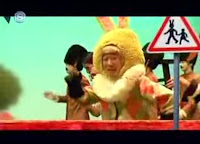 g less than delectable. And Japanese video games have invented the industry. So why is J-Pop so unlistenable? Oh yeah... They don't have black people in Japan."
I love "relentlessly horrendous crap" - couldn't find a better expression to describe the J-Pop phenomenon! All the flatteries are correct too, especially the one on fashion, Japanese people tend to look like stylish time travellers from the 22nd century. The last comment has to be corrected though, there are black musicians in Japan, but they now sing Enka, traditional Japanese folk songs, or "Schlager" as we call it in German. I am refering to Jero, the black singer I've read about in a magazine in July and who's now all over tv channels in Japan. A HipHop-looking guy singing cheesy Japanese songs.
Well, here's the J-Pop hit of the week. I handpicked it for my dear blog readers for it's poor quality music and the examplarily silly video. TV watchers of MTV Japan and other music channels are tortured with it every day right now...
 a little boring. But I got a free spectacle that certainly made excellent entertainment.
 for nanpa...
 scouted the area for girls to tackle and chose the appropriate team member to address her instantly. I seem to be the macho type target - lol. When I arrived the guy too a closer look at me and seemed to consider addressing me. But they are cowards, so the risk of me not speaking Japanese seemed too big I guess. It was really funny to watch and they were very busy as the approach of Nanpa is not class but mass. Chat up as many girls as possible and try to get their phone numbers. Most will probably be annoyed and leave, but if you approach enough you will get SOME phone numbers. That is the philosophy of Nanpa I guess. The girly guy targeted the dolly girls, the "Hime" gal, princess girl and the super fashionistas. The macho targeted the more streetsy but still fashionable type. And the nerd the shy, office girl type. Despite the obvious stupidity of the endeavour as such I thought their way of approaching the "market" was kind of brilliant.